The Rise and Fall of Sisyphus
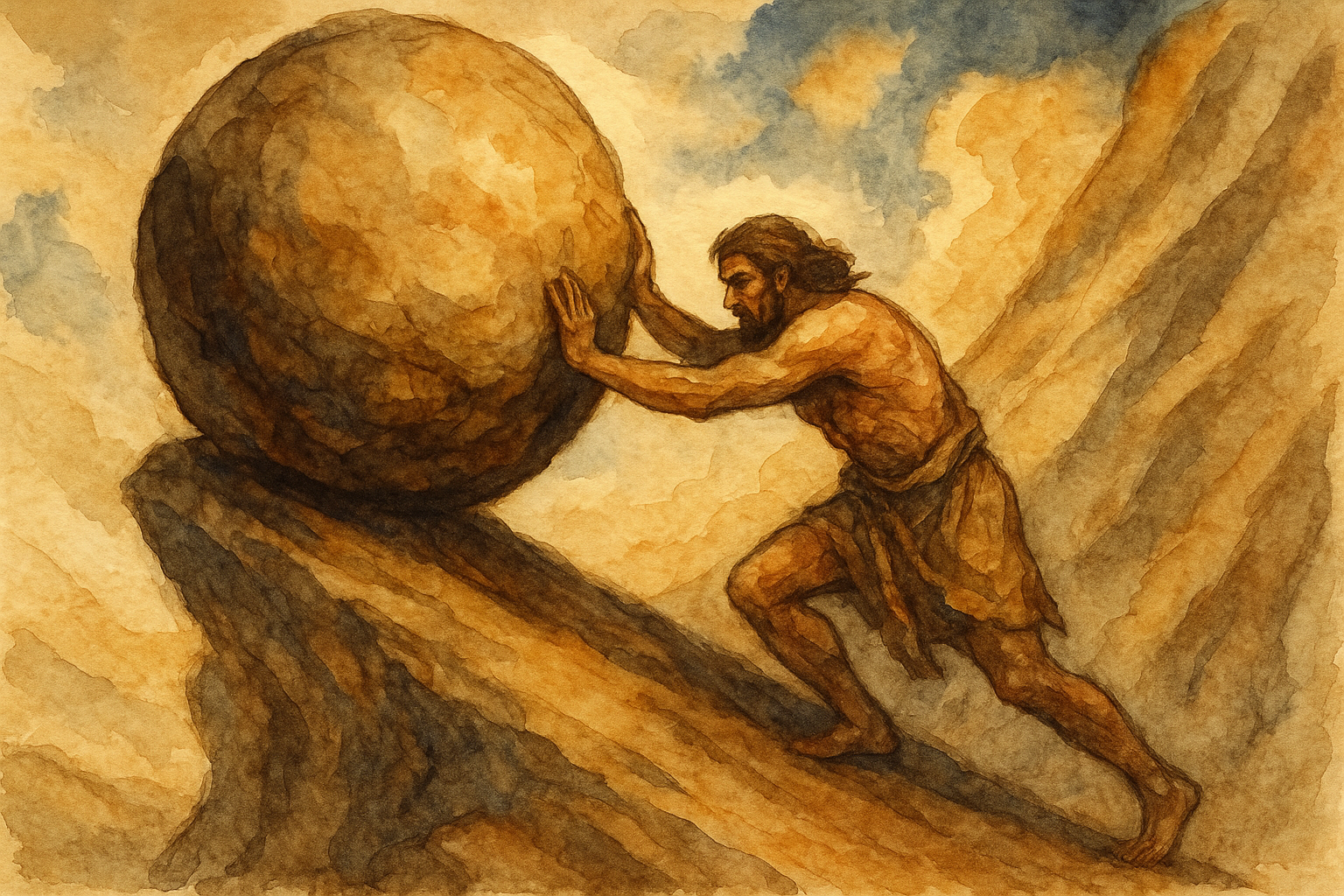
This month we explore the rise and fall and Sisyphus. What can we learn from the man who evaded death and the December astrological transits?
The Myth
The story begins with a betrayal. Sisyphus, ruler of Corinth, desired a new water source for his city. A man of few scruples, he didn’t see any harm in betraying Zeus’ confidence when given the opportunity to trade information about Zeus’ secret love affair with Aegina, daughter of the river god, Asopus, for a beautiful fresh water well.
Furious that he had been betrayed, Zeus ordered Thanatos, the god of death, to arrest and punish Sisyphus. However, Sisyphus, cunning as he was, convinced Thanatos to handcuff himself in order to demonstrate how the manacles worked. Quickly, Sisyphus closed the irons around Thanatos’ wrists and hid Thanatos away.
Thanatos’ imprisonment was a terrible time for the world as no one could die. The elderly, the wounded, the young, all were kept in unending pain unable to make the final crossing. Unable to slaughter animals, people starved. The Gods searched for Thanatos but could not find him anywhere. When Ares finally found Thanatos and freed him, Thanatos decreed that Sisyphus would suffer in the underworld for his crimes.
Before embarking on his journey to the underworld, Sisyphus ordered his wife not to bury his body. As he stood before Persephone, he pleaded with her saying that his wife had been cruel and had not performed the funeral rites, nor buried him with a coin beneath his tongue to pay the ferryman, Charon, for passage across the River Styx. He asked to be given three days to ascend back to the world to arrange for a proper burial. Persephone agreed but demanded he return within three days.
Delighted by his freedoms Sisyphus did not return but lived out the remainder of his days in the land of the living until he died an old man.
However, upon his death, he was sentenced to eternal punishment for his crimes and trickery of the Gods. He would have to roll a heavy, immense boulder up a mountain. Yet, every time it was about to reach the summit the boulder would roll to the bottom of the mountain and he’d have to start the task over again. And so it was for all eternity.
The Cosmic Connection
Traditionally, the Myth of Sisyphus is seen as a universal rendering of the existential nature of being human, popularized by Albert Camus’ interpretation. And while there is definitely merit to this understanding, the task of constantly striving to reach the end only to be back at the beginning, I would like to offer a different understanding of the myth and its relationship to the planetary transits in December.
Kurt Vonnegut once proposed that stories have shapes, most of which can be illustrated by some type of sine wave form. These wave forms viscerally impact us on a physiological and psychological level, inherent to the somatic structure of nature.
The Myth of Sisyphus follows the structure of rise and fall, rise and fall, rise and fall. This structure can be seen in many of nature’s patterns. Waves. Plants. Universes. And Breath. According to mythologist Joseph Sansonese, even the name Sisyphus is onomatopoetic of the in and out breath.
As we transition from Sagittarius season to Capricorn season, and the depth of winter, it’s vital to remember that we are in the perpetual rise and fall of the cosmic order. This time of inwardness will be followed by a time of outwardness.
A key player this month is Mars. As in the story, it is Ares (the god of war) who finds and frees Thanatos from his imprisonment. In December, Mars transitions from Sagittarius into Capricorn on the 15th, bringing with it the energy of unearthing that which we have hidden away and breaking free from the shackles that have kept us bound up within ourselves. Capricorn energy gives us the support to face ourselves realistically and a scaffolding to prevent internal collapse after having journeyed through the vast philosophical and enlarging energies of Sagittarius season. Where can we ground and find our roots as we welcome in the depths of winter?
The breath can help us find these places that have remained hidden.
The other aspect that I think is particularly resonant is the relationship between Mercury and Uranus in December. Mercury will oppose Uranus for the third time this month. Sisyphus is mercurial by nature, tricking and entrapping the gods, flitting between worlds, and he imbues his mercurial trickery with Uranian energy in order to rebel, shock, and reinvent his life in the face of death. This astrological opposition has the potential to bring up this dynamic within ourselves. Where are we hiding in the depths of our own self deception? Perhaps the way forward in this time is to see how we creatively keep patterns that no longer serve us alive instead of giving them over to Thanatos, god of death. It is not life itself that creates the existential suffering but the unchallenged assumptions that unconsciously run our lives, yielding the same results no matter the effort. It is only through questioning the assumptions and allowing the old beliefs to die that our Sisyphean task resolves.
As in the myth, the inability to let things die is a terrible time for the world. Death is essential, and so we must face our own trickery. Uranus energy also lends itself to a reinvention or a new order of our lives that can only emerge when old ways of being have died.
In meeting this myth within you, I offer this for contemplation. What identity are you keeping alive that may be wreaking havoc on your inner world?
As we move into the month, I encourage you to sit with any themes, symbols, characters, or ideas that resonated with you from the myth. As you sit with them, you will undoubtedly be brought into alchemical connection with the astrological events. You don’t need to know anything about your own chart to navigate the current transits but of course, if you would like to know more about your own chart and how it relates to these times, I encourage you to contact me!
Some ideas for engaging with this myth:
Create a list of who you think you are. Then negate each of those items (ie, I am a mother; I am not a mother). Sit with the result of this list.
Engage with any pertinent dream imagery that emerges
Explore myths and stories that deal with tricksters
Spend a few minutes a day engaging with your breath and any subsequent emotions, feelings, thoughts, images, memories, or sensations
Honor each evening as a small death to the life you lived that day